The hardest code to delete is your own
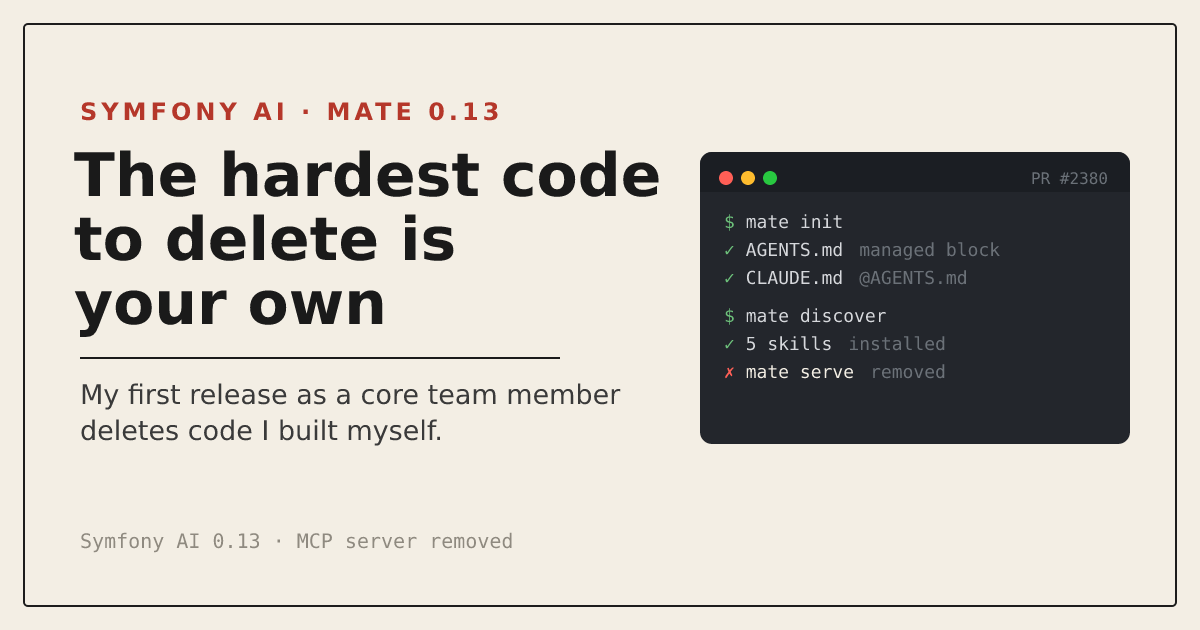
By Johannes Wachter, Sulu core developer. The wrong debate made the argument, Kill the MCP made the bet, and The Mate Lab measured it. This is what shipping the answer actually cost.
My first Symfony AI release as a core team member deletes the MCP server from Mate.
That sentence feels stranger to write than I expected.
Mate started as an MCP server. I built it that way, talked about it that way, gave a conference talk about it that way, and spent months making that architecture work. And the first release since I joined the Symfony AI core team is the one that removes it.
Mate was an MCP project
None of it happened by accident. The SDK, the server process, the client configuration, the workarounds for clients that didn’t quite implement the protocol the way the spec suggested, all of it existed because MCP was the premise, not a detail underneath it.
A few weeks ago I called the experiment Kill the MCP. At the time it was deliberately provocative: could Mate keep its tools, schemas and knowledge while treating MCP itself as replaceable?
It could. But not in the naive form I first built.
The first CLI was invisible
My first replacement for the server was a few CLI commands and nothing else. In the experiment I describe in The Mate Lab, an agent with only that CLI never used it: zero out of twenty runs, on two tasks, with a small model.
That is a small sample, but the cause was clear. MCP had been providing discovery as well as transport. If I wanted to remove one, I had to deliberately rebuild the other.
What actually shipped
Once I separated the protocol from the capabilities, surprisingly little of what mattered actually depended on MCP. The tools, their schemas, the runtime access Mate gives an agent, the knowledge encoded in skills, discovery itself, none of that needed to live inside an MCP server. What needed to go was the coupling between those things and one specific transport.
PR #2380 does exactly that. The MCP server and the mcp/sdk dependency are gone, along with
mate serve and mate stop. The tools remain, reachable through the CLI. mate init and
mate discover, the managed block they write into AGENTS.md, and the skills layered on top
carry the discoverability MCP used to provide for free.
“Kill the transport, not the capability” wasn’t a new idea by the time this shipped. It was the old one, now sitting in released code instead of an argument.
The code was mine
There is a particular kind of resistance when the code you are deleting is code you wrote yourself.
The MCP server wasn’t legacy code somebody else had left behind. I had chosen the SDK, built the integration, added lifecycle commands, generated client configuration and worked around clients that didn’t quite fit. Some of those workarounds were clever. Some took a lot of time.
None of that is an argument for keeping the architecture.
The amount of work that went into an architecture says surprisingly little about whether it should survive the next one.
I joined the Symfony AI core team thinking mostly about what I might get to build next.
But I also knew what I didn’t want my first release to become: an excuse to put another layer of my own on top of the project. If an architecture I had built no longer earned its place, having more responsibility for the project was a reason to remove it, not protect it.
Mate started as an MCP server. In 0.13, that server is gone.
The part I wanted to keep was never the protocol. It was what Mate lets an agent see happening in your runtime.
Links & resources
- Part 1: The wrong debate: what PHP taught me about agentic software
- Part 2: Kill the MCP
- The measurement in between: The Mate Lab: does an agent actually use a dev tool?
- The merged PR: symfony/ai#2380
- Symfony Mate: github.com/symfony/ai-mate